


IELTS Speaking Part 3 is often considered the most challenging section of the speaking test. The questions are deeper, more abstract, and require you to express opinions, analyse ideas, and discuss broader issues. For many candidates, this shift can feel intimidating.
However, Band 9 candidates approach Part 3 with clarity and structure. At IELTS Sure, we teach students how to treat this section as a guided discussion rather than an interrogation.
JOIN OUR WHATSAPP GROUP FOR UPDATES
Table of Contents
What Is IELTS Speaking Part 3?
Speaking Part 3 follows directly after Part 2 and lasts about four to five minutes. The examiner asks questions related to the topic you discussed in your long turn, but at a more general and analytical level.
Instead of talking about personal experiences, you are expected to discuss trends, opinions, causes, effects, and possible solutions.
The examiner is assessing your ability to explain and support ideas clearly, not your specialist knowledge.
How Band 9 Candidates Answer Part 3 Questions
High scoring candidates do not rush their answers. They take a brief moment to think, then respond with a clear position followed by explanation.
Their answers usually include:
| Element | Purpose |
|---|---|
| Clear opinion | Shows confidence and direction |
| Explanation | Develops the idea logically |
| Example | Makes the answer concrete |
| Reflection | Adds depth or balance |
This approach keeps answers focused and avoids vague or incomplete responses.
The Ideal Structure for Part 3 Answers
Band 9 candidates rely on a flexible structure that can be adapted to almost any question.
| Step | What to Include |
|---|---|
| 1 | Direct answer to the question |
| 2 | Reason or cause |
| 3 | Example or comparison |
| 4 | Result, consequence, or future view |
For example, if asked about changes in education, a strong response might explain what has changed, why it happened, and how it affects society.
ALSO READ: Mastering IELTS Speaking Part 1 with Confidence
Using Complex Ideas Without Overcomplicating Language
Many candidates think they must use very advanced vocabulary in Part 3. In reality, examiners value clarity more than complexity.
Band 9 speakers use a mix of simple and complex sentences, linking ideas naturally with phrases like on the other hand, as a result, and in contrast.
They explain abstract ideas in a calm, organised way, making their answers easy to follow.
Handling Difficult or Unexpected Questions
It is normal to face a question you have never thought about before. Band 9 candidates do not panic. They use thinking phrases to gain time, such as:
- That is an interesting question
- I have not considered this before, but I think
- From my perspective
These phrases sound natural and help you organise your thoughts without losing fluency.
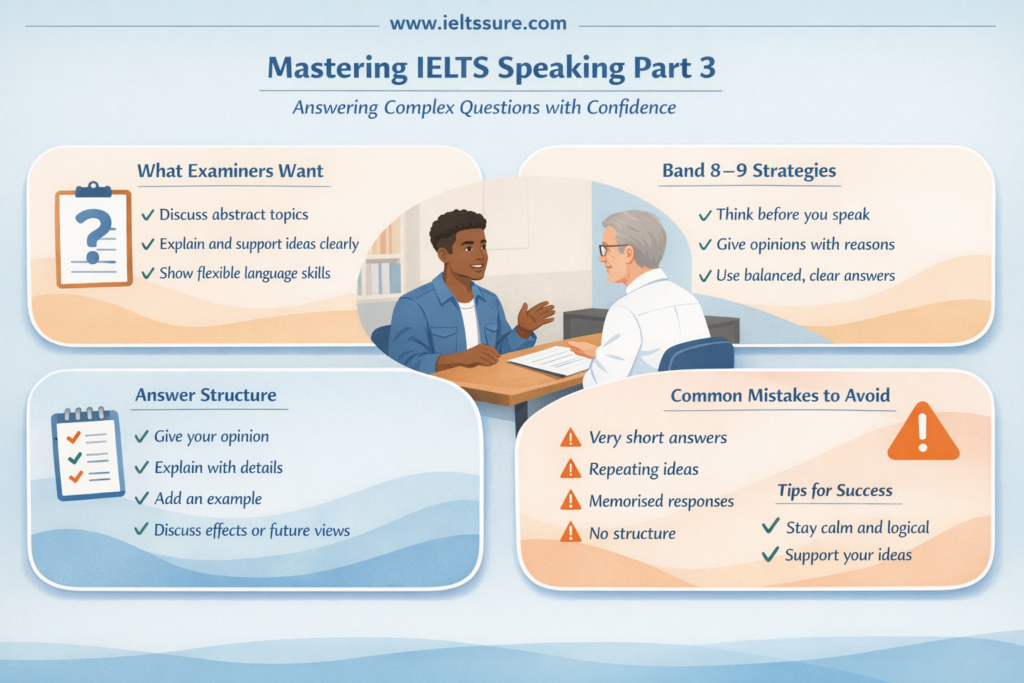
Common Mistakes That Lower Part 3 Scores
Avoiding certain habits can make a big difference to your final score.
Be careful not to:
- Give very short answers
- Repeat the same idea in different words
- Memorise opinions
- Avoid the question
- Speak without structure
Part 3 rewards depth and clarity, not speed.
How Part 3 Affects Your Overall Speaking Score
Speaking Part 3 plays a major role in your final band score because it shows your ability to use language flexibly. Strong performance here often separates Band 6 candidates from Band 7 and above.
This is where examiners look for mature language use, logical development, and the ability to handle complex ideas calmly.
Final Advice on IELTS Speaking Part 3
Think of Speaking Part 3 as a discussion with an examiner who wants to hear how you think. There are no right or wrong answers, only clear or unclear explanations.
If you state your opinion, explain it logically, and support it with examples, you are already performing at a high level. Stay calm, listen carefully, and focus on communicating your ideas clearly and confidently.
JOIN OUR WHATSAPP GROUP FOR UPDATES
Frequently Asked Questions about IELTS Speaking Part 2
You should speak for between one and two minutes. Band 9 candidates usually speak close to the full two minutes while staying relevant and well structured.
Write short keywords, not full sentences. Focus on ideas for each bullet point, one personal example, and a simple ending to help you stay organised while speaking.
You should address all bullet points, but not mechanically. Use them as a guide and develop your answer naturally rather than treating them as separate questions.
Yes. Short pauses to think are completely acceptable. Examiners prefer natural pauses over rushing, memorised answers, or repeating ideas.
No. Memorised answers are easy for examiners to detect and can reduce your score. Focus on flexible structures and natural language instead.
Finishing early may limit your fluency score. To avoid this, extend ideas by explaining reasons, describing feelings, or reflecting on why the topic is meaningful.