


Scoring a Band 9 in IELTS Listening is not about luck or having a native accent. It is about accuracy, strategy, and knowing how the test really works. Many candidates assume Listening is the easiest paper, yet small mistakes often stop them from reaching top scores. At IELTS Sure, we train students to listen actively, predict intelligently, and answer with confidence.
This guide breaks down how Band 9 candidates approach the Listening test and what you can do to reach the same level.
JOIN OUR WHATSAPP GROUP FOR UPDATES
Table of Contents
What a Band 9 Score Really Means
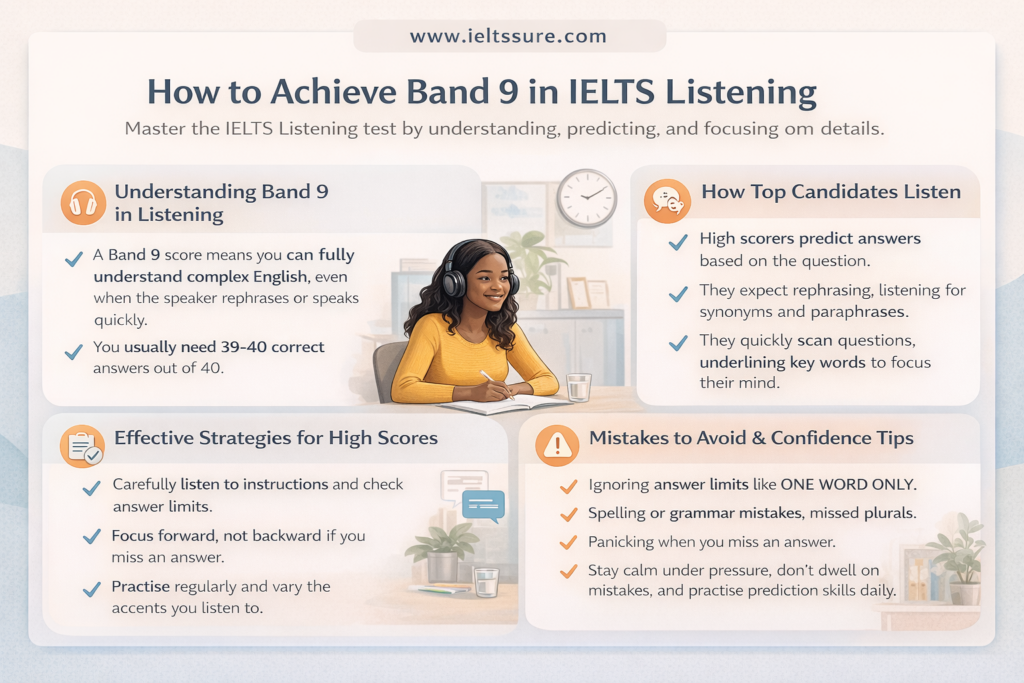
A Band 9 in IELTS Listening means you can understand spoken English fully, even when the speaker changes direction, speaks quickly, or includes detail. To achieve this, you usually need 39 or 40 correct answers out of 40.
That margin leaves no room for careless spelling mistakes, missed plurals, or misunderstood instructions.
Understanding the IELTS Listening Structure
The Listening test contains four sections, each increasing in difficulty. Knowing what to expect helps you stay calm and focused.
| Section | Context | Difficulty Level |
|---|---|---|
| Section 1 | Social conversation | Easy |
| Section 2 | Social monologue | Easy to moderate |
| Section 3 | Academic discussion | Challenging |
| Section 4 | Academic lecture | Most difficult |
Band 9 candidates do not treat all sections the same. They save mental energy for Sections 3 and 4, where most errors occur.
ALSO READ: 6 Common IELTS Listening Traps and How to Avoid Them
How Band 9 Candidates Listen Differently
High scorers do not simply listen for words, they listen for meaning and direction. They actively predict what information is coming next based on the question.
Before the audio starts, they quickly scan the questions and underline key words. This allows them to recognise answers instantly instead of processing information too late.
They also expect paraphrasing. The speaker rarely uses the exact words from the question, so Band 9 listeners focus on synonyms and rephrased ideas.
Mastering Instructions and Answer Limits
One of the biggest score killers in IELTS Listening is ignoring instructions. Words like NO MORE THAN TWO WORDS AND OR A NUMBER are non negotiable.
Band 9 candidates check answer limits before every section and adjust their writing accordingly.
| Instruction | Correct Answer Example | Incorrect Example |
|---|---|---|
| One word only | library | the library |
| No more than two words | evening classes | classes in the evening |
| A number | 15 | fifteen |
Writing more words than allowed results in a wrong answer, even if the meaning is correct.
Spelling, Plurals, and Grammar Matter
Listening is not just about hearing the answer, it is also about writing it correctly. Band 9 candidates pay attention to:
• Singular and plural forms
• Capital letters where required
• Correct spelling of common academic words
British and American spelling are both accepted, but consistency is essential.
Staying Focused When the Answer Passes
If you miss an answer, move on immediately. Band 9 candidates do not panic or dwell on lost points. Each section only plays once, and losing focus for ten seconds can cost several questions.
They listen forward, not backward.
Daily Practice Habits of Band 9 Scorers
Top scorers build listening skills gradually, not crammed before the exam. Effective habits include:
• Practising with real IELTS style recordings
• Listening to different English accents
• Reviewing mistakes and understanding why answers were wrong
• Training prediction skills, not just doing tests
At IELTS Sure, we emphasise smart practice over endless repetition.
Conclusion
Achieving Band 9 in IELTS Listening is realistic if you approach the test strategically. Focus on prediction, instruction accuracy, spelling discipline, and calm listening under pressure. With the right techniques and consistent practice, you can turn Listening into your strongest paper.
JOIN OUR WHATSAPP GROUP FOR UPDATES
Frequently Asked Questions
Yes, it is possible. A Band 9 score requires near perfect accuracy, usually 39 or 40 correct answers. With strong listening skills, careful attention to instructions, and consistent practice using real IELTS style materials, many candidates achieve this score.
You can usually make one mistake and still score Band 9. Any more than that may drop your score to Band 8.5 or lower, depending on overall accuracy.
Section 4 is generally the most difficult because it involves an academic lecture with no breaks. Section 3 can also be challenging due to multiple speakers and changing opinions.
Yes. Spelling mistakes, incorrect plurals, or writing more words than allowed will result in lost marks, even if you understand the correct answer.
You can use either British or American spelling. The key is consistency and correct spelling throughout the test.
Before each recording starts, quickly read the questions, underline key words, and think about the type of information needed. This helps you recognise answers faster during the audio.
Move on immediately. Staying focused on upcoming questions is far more important than worrying about a missed answer.