

Learn how IELTS helps you get a job abroad by meeting visa requirements, impressing employers, and building real workplace English skills in this practical guide for international job seekers. Working abroad is a goal for millions of professionals worldwide. Higher salaries, international exposure, better living standards, and long-term career growth make overseas employment highly attractive.
However, before skills, experience, or qualifications are considered, employers and immigration authorities often ask one key question:
Can you work effectively in English?
This is where IELTS plays a critical role.
IELTS is not just an English test. It is one of the most widely accepted tools for proving that you are ready to work in an English-speaking environment. In this guide, we explain exactly how IELTS helps you get a job abroad and why it is essential for international employment.
JOIN OUR WHATSAPP GROUP FOR UPDATES
Table of Contents
1. IELTS Is Required for Many Work Visas if You’re Aiming For a Job Abroad
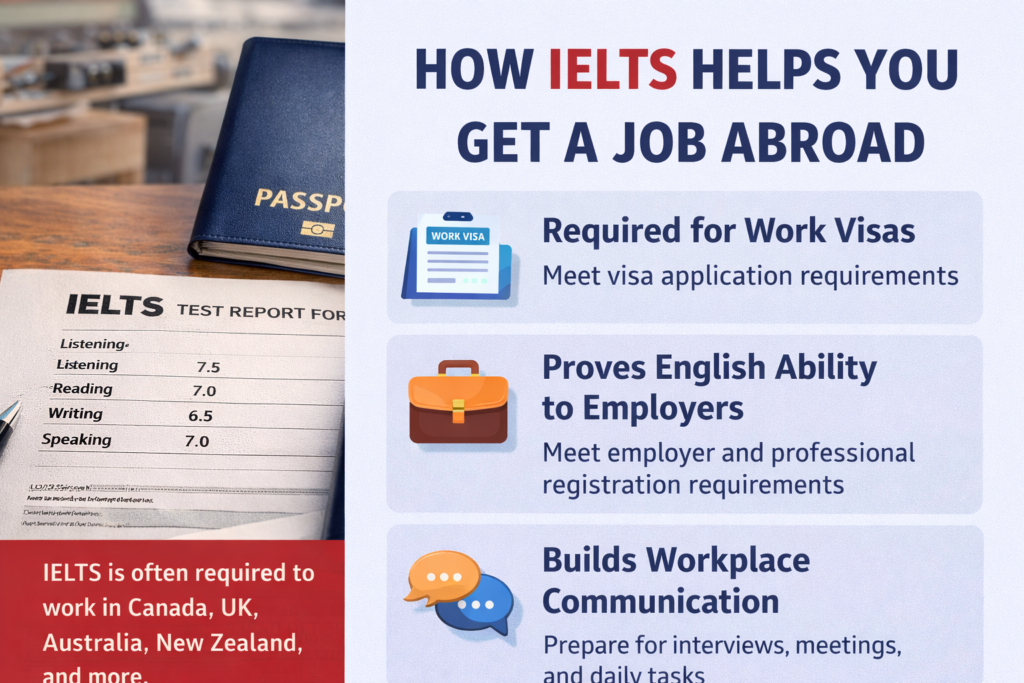
In many countries, IELTS is a mandatory requirement for work visas and skilled migration programmes.
Even if you have:
- Strong qualifications
- Years of experience
- A job offer
your application may be rejected without the required IELTS score.
IELTS is commonly used in:
- Skilled worker visas
- Permanent residence programmes
- Professional licensing and registration
Without IELTS, your career plans abroad may never move past the application stage.
2. Employers Use IELTS to Assess Workplace English Skills
International employers want to be sure you can:
- Understand instructions and safety procedures
- Communicate clearly with colleagues and clients
- Participate in meetings and teamwork
- Write professional emails and reports
An IELTS score gives employers objective proof of your English ability.
A strong score shows that you:
- Can function independently at work
- Will integrate faster into the organisation
- Require less language training
In competitive job markets, this can significantly improve your chances of being hired.
ALSO READ: 6 Common IELTS Listening Traps and How to Avoid Them
3. IELTS Builds Practical English for the Workplace
IELTS preparation develops real-world communication skills that are directly useful at work.
Each test section connects to professional tasks:
- Listening – meetings, briefings, phone calls
- Speaking – interviews, discussions, presentations
- Reading – contracts, policies, manuals, emails
- Writing – reports, proposals, workplace correspondence
Preparing for IELTS does not only help you pass an exam. It prepares you to perform confidently in an English-speaking job.
4. IELTS Improves Your Job Interview Performance
Many qualified candidates struggle in international job interviews because they cannot express themselves clearly in English.
IELTS Speaking preparation helps you:
- Structure answers logically
- Speak fluently under pressure
- Explain ideas, experiences, and opinions clearly
These are exactly the skills required in job interviews.
Candidates who prepare well for IELTS often find interviews easier because they are trained to:
- Think in English
- Respond naturally
- Communicate with confidence
5. IELTS Strengthens Your CV and LinkedIn Profile
Including your IELTS score on:
- Your CV
- Your LinkedIn profile
- Job applications
adds instant credibility when applying for jobs abroad.
It tells employers that:
- Your English has been independently tested
- You meet international language standards
- You are serious about working overseas
This often increases shortlisting opportunities and recruiter confidence.
6. IELTS Is Accepted Worldwide for Employment
One major advantage of IELTS is its global recognition.
Your IELTS score can be used for:
- Jobs in multiple countries
- Different visa categories
- Employer and immigration applications
This flexibility allows you to explore opportunities across borders without retaking multiple language tests.
7. IELTS General Training vs Academic if You Want to Get a Job Abroad
Many job seekers are unsure which IELTS test to take.
In general:
- IELTS General Training is used for work, migration, and practical workplace contexts
- IELTS Academic is mainly required for professional registration or regulated occupations
Choosing the correct test type is essential to avoid delays or rejections.
Conclusion: IELTS as a Career Tool
If you want to get a job abroad, think of IELTS as more than an exam result. It is a career investment.
It helps you:
- Meet work visa requirements
- Prove your English to employers
- Perform better in job interviews
- Communicate effectively at work
- Compete confidently in the global job market
If working abroad is part of your plan, IELTS is not optional. It is strategic.
At IELTSsure, we focus on helping candidates build real English skills, not just exam scores, so they can succeed both in the test and in their careers.
Your job abroad starts with preparation.
IELTS is the first step.