


IELTS Listening map and plan labelling questions often feel intimidating at first glance. Many candidates panic when they see a complex layout filled with rooms, paths, and unfamiliar locations. However, once you understand how these questions work and apply the right strategies, they become one of the most manageable parts of the Listening test.
At IELTS Sure, we teach students how to approach these questions calmly, logically, and with confidence.
JOIN OUR WHATSAPP GROUP FOR UPDATES
Table of Contents
What Are IELTS Listening Map and Plan Labelling Questions?
In this task, you are given a visual diagram, usually a map of an area or a plan of a building. While listening to the audio, you must label specific locations based on the speaker’s directions.
Maps usually show outdoor spaces such as parks, streets, or campuses. Plans focus on indoor areas like museums, hotels, or office buildings. The task is not about artistic interpretation, it is about following spoken directions accurately.
These questions test your ability to understand location language, directions, and spatial relationships.
Why Candidates Lose Marks When Tackling IELTS Listening Map and Plan Labelling Questions
Many test takers struggle because they try to read the map while listening, instead of preparing beforehand. Others fail to recognise common directional phrases or miss answers because they panic when they lose their place.
The good news is that these mistakes are predictable and avoidable.
Step One, Study the Map Before the Audio Starts
Before the recording plays, you are given time to look at the map. Use this time wisely.
Start by identifying the starting point. This is often clearly marked. Next, notice landmarks, entrances, exits, and main paths. Pay attention to the compass direction if one is shown.
Do not try to memorise everything. Instead, aim to understand the overall layout and flow of the space.
IELTS Listening Prediction Skills: Turn Anxiety Into Control and Rise to Band 7+
Step Two, Predict the Type of Answers
Look carefully at the instructions. They will tell you how many words you can write. Most map labelling questions require one or two words.
Check whether the answers are already written on the map or if you must choose from a list. This helps you listen more selectively and avoid spelling mistakes.
Common Directional Language to Listen For
The speaker will guide you step by step using clear directional phrases. Being familiar with this language gives you a huge advantage.
| Common Phrase | Meaning |
|---|---|
| Opposite | Directly facing |
| Next to | Beside |
| On the left of | To the left side |
| At the end of | Final point |
| Go past | Move beyond |
| In the corner | Where two sides meet |
Train your ear to recognise these phrases quickly and your accuracy will improve immediately.
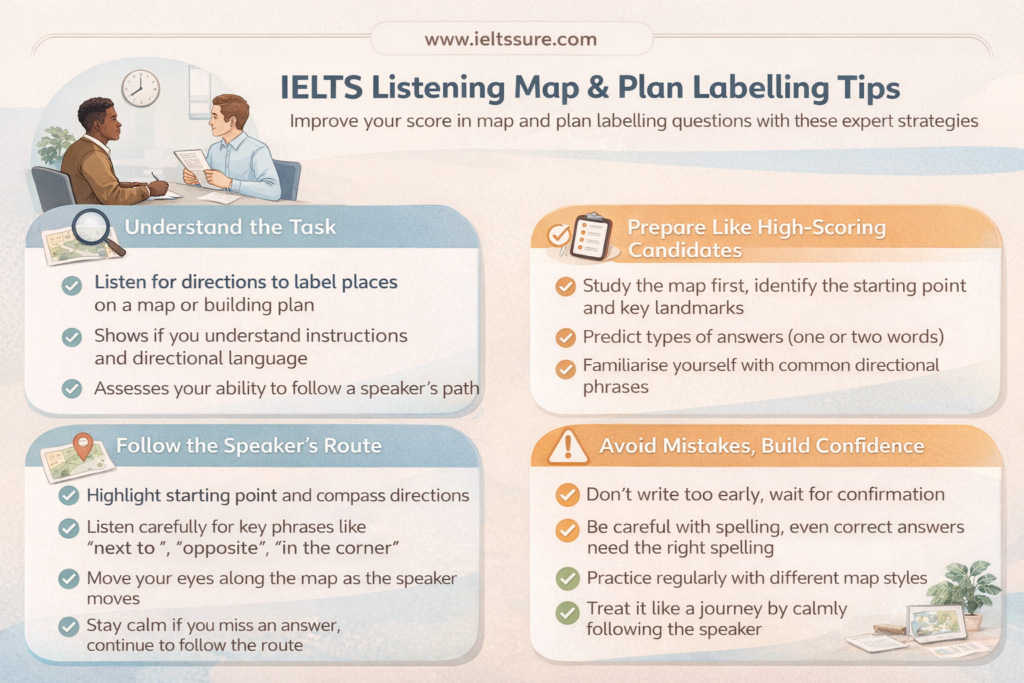
Follow the Speaker’s Movement Carefully
The audio almost always follows a logical route. The speaker starts at a known location and moves step by step. Follow this movement with your eyes as you listen.
If you miss one answer, do not panic. Keep following the directions and move on. The next answer will usually be nearby.
Remember, answers come in the same order as the audio.
Avoid Common Traps
One common trap is writing too early. Sometimes the speaker mentions a location only to correct themselves. Always wait until the information is confirmed.
Another trap is spelling. Even if your understanding is perfect, incorrect spelling will cost you marks. Write clearly and stick to simple, accurate spellings.
Practice Makes This Question Type Predictable
With regular practice, map labelling becomes highly predictable. You will start to notice repeating language patterns and common layouts.
At IELTS Sure, we encourage students to practise with different map styles so they feel comfortable no matter what appears on test day.
Conclusion
IELTS Listening map and plan labelling questions reward calm thinking and focused listening. When you prepare properly, understand direction language, and follow the speaker’s path, these questions can become a reliable source of marks.
Treat the map like a journey, not a puzzle, and you will approach this task with confidence and clarity.