


What are the most common IELTS Listening traps? Many IELTS candidates believe that the Listening test is straightforward, yet it is one of the sections where scores often fall unexpectedly. At IELTS Sure, we see this happen not because students lack English ability, but because they fall into common listening traps that are carefully built into the test.
Understanding these traps, and knowing how to avoid them, can immediately improve your Listening score.
JOIN OUR WHATSAPP GROUP FOR UPDATES
Table of Contents
Why IELTS Listening Feels Tricky – Overcoming IELTS Listening Traps
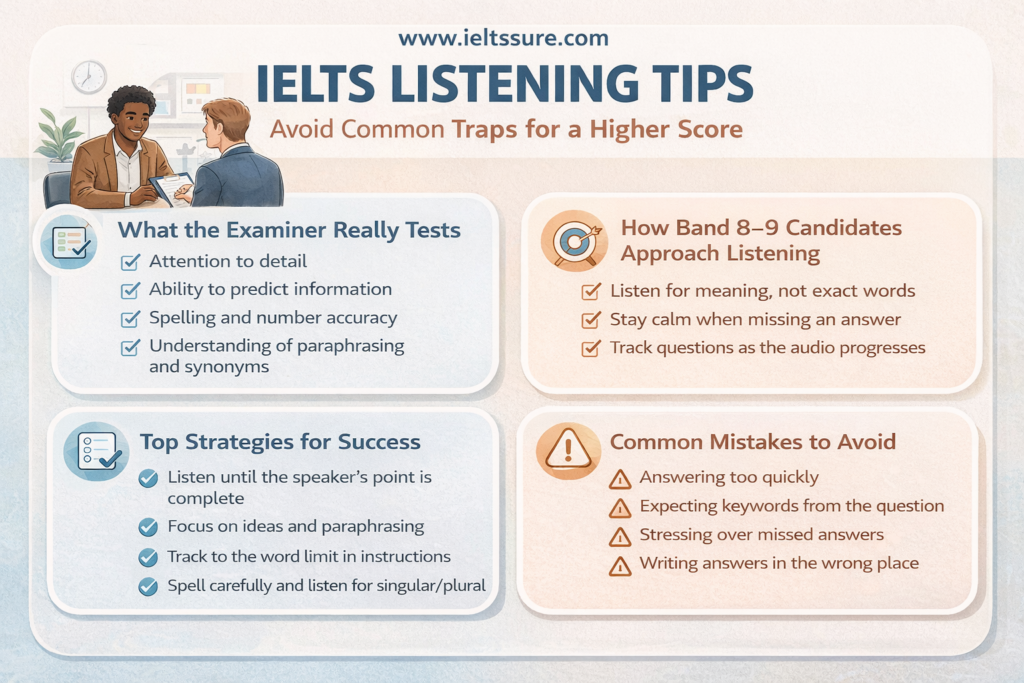
The IELTS Listening test is designed to test more than just hearing words. It assesses attention, prediction skills, spelling accuracy, and your ability to follow meaning in real time. The test writers intentionally include distractions to catch candidates who listen carelessly or rely on assumptions.
Once you recognise these patterns, the test becomes far more manageable.
IELTS Listening Trap 1: Answering Too Quickly
One of the most common mistakes is choosing the first answer that sounds correct. In IELTS Listening, the speaker often mentions one idea, then corrects it or replaces it with the real answer.
For example, a speaker may say a meeting is on Tuesday, then later clarify that it has been moved to Thursday. If you stop listening after hearing Tuesday, you will miss the correct answer.
How to avoid it
Always listen until the speaker finishes the idea. Do not write your answer permanently until you are sure no correction follows.
IELTS Listening Trap 2: Expecting Exact Words from the Question
Many candidates listen only for the exact words written in the question. However, IELTS frequently uses paraphrasing, synonyms, and rewording.
For example, the question may say “cost”, but the speaker says “fee” or “price”. If you are waiting for the exact word, you may miss the answer completely.
How to avoid it
Train yourself to recognise meaning rather than individual words. Focus on understanding the idea being expressed, not just matching vocabulary.
IELTS Listening Trap 3: Losing Focus After One Missed Answer
Missing one answer often causes panic, and that panic leads to missing several more. The audio does not pause, so worrying about a previous question only harms your performance further.
How to avoid it
If you miss an answer, let it go immediately. Move your attention to the next question. One missed question will not destroy your score, but losing focus might.
IELTS Listening Trap 4: Ignoring Instructions and Word Limits
Many correct answers are marked wrong because candidates exceed the word limit or write unnecessary words. For example, if the instruction says “NO MORE THAN TWO WORDS”, writing three words will result in zero marks, even if the idea is correct.
How to avoid it
Read the instructions before each section carefully. Keep answers short and precise, and never exceed the stated limit.
Trap 5: Poor Spelling and Singular Plural Errors
IELTS Listening tests spelling accuracy. A correct idea written with incorrect spelling is marked wrong. The same applies to singular and plural forms.
Common examples of errors
| Audio Says | Correct Answer | Common Mistake |
|---|---|---|
| students | students | student |
| libraries | libraries | library |
| accommodation | accommodation | accomodation |
How to avoid it
Practise spelling common IELTS words and listen carefully for plural markers like “s” and “es”.
ALSO READ: Mastering IELTS Listening Map and Plan Labelling for Achieving Your Dream Band 7+ Score
Trap 6: Writing Answers in the Wrong Place
Some candidates hear the correct answer but write it next to the wrong question number, especially when they fall behind during the recording.
How to avoid it
Use your finger or pencil to track questions as the audio progresses. Stay aligned with the flow of the recording.
Conclusion
The IELTS Listening test rewards calm, focused, and strategic listeners, not rushed or reactive ones. By recognising these common traps and practising smarter listening habits, you can significantly improve your accuracy and confidence.
At IELTS Sure, we encourage students to treat Listening as a skill that can be trained, not a mystery that must be guessed. With awareness, practice, and the right techniques, a higher Listening score is well within reach.
JOIN OUR WHATSAPP GROUP FOR UPDATES
Frequently Asked Questions
Many candidates lose marks due to common listening traps rather than poor English. These include answering too quickly, missing paraphrased information, spelling errors, or exceeding word limits. Avoiding these mistakes can significantly improve your score.
No. IELTS frequently uses synonyms and paraphrasing. Listening for meaning rather than exact wording is essential to identify correct answers.
Move on immediately. The recording does not pause, and focusing on a missed answer often leads to missing several more. Stay calm and focus on the next question.
Spelling and singular or plural accuracy are extremely important. Even if the idea is correct, spelling mistakes or incorrect plural forms will result in lost marks.
No. If the instructions say “NO MORE THAN TWO WORDS”, exceeding the limit results in zero marks, even if the answer is logically correct.