


IELTS Speaking Part 2 is where many candidates feel the pressure rise. You are given a topic card, one minute to prepare, and then asked to speak for up to two minutes without interruption. For some, this feels intimidating, but for Band 9 candidates, it is an opportunity to showcase fluency, structure, and confidence.
At IELTS Sure, we train students to see Part 2 not as a challenge, but as a controlled performance with a clear strategy.
JOIN OUR WHATSAPP GROUP FOR UPDATES
Table of Contents
What Is IELTS Speaking Part 2?
Speaking Part 2 is known as the long turn. You receive a cue card with a topic and four bullet points. These prompts guide your answer, but they are not questions you must answer one by one.
Your task is to speak continuously for one to two minutes, developing your ideas naturally while staying relevant to the topic.
The examiner is assessing fluency, coherence, vocabulary, and grammatical control, not your creativity or intelligence.
How Band 9 Candidates Use the One Minute Preparation Time
The one minute preparation time is critical. High scoring candidates do not write full sentences. They jot down short keywords that help them stay organised while speaking.
A strong plan looks like this:
| Preparation Focus | What to Note |
|---|---|
| Opening idea | What the topic is about |
| Key points | Short words for each bullet |
| Personal detail | Example or experience |
| Ending | How to conclude smoothly |
This quick outline acts like a mental map, keeping your speech focused and flowing.
The Band 9 Speaking Structure
Band 9 candidates do not speak randomly. Their answers follow a simple but effective structure.
| Stage | What to Do |
|---|---|
| Introduction | Paraphrase the topic naturally |
| Development | Expand on each point with detail |
| Example | Add a personal or realistic example |
| Conclusion | Summarise or reflect briefly |
This structure helps you avoid long pauses and keeps your response coherent.
How to Speak for Two Minutes Without Running Out of Ideas
A common fear is finishing too early. Band 9 candidates manage time by extending ideas naturally, not by repeating themselves.
They use techniques such as:
- Explaining reasons
- Describing feelings or outcomes
- Adding comparisons or contrasts
- Reflecting on why something was meaningful
For example, instead of simply describing an event, they explain how it affected them and why it still matters today.
ALSO READ: Mastering IELTS Speaking Part 1 with Confidence
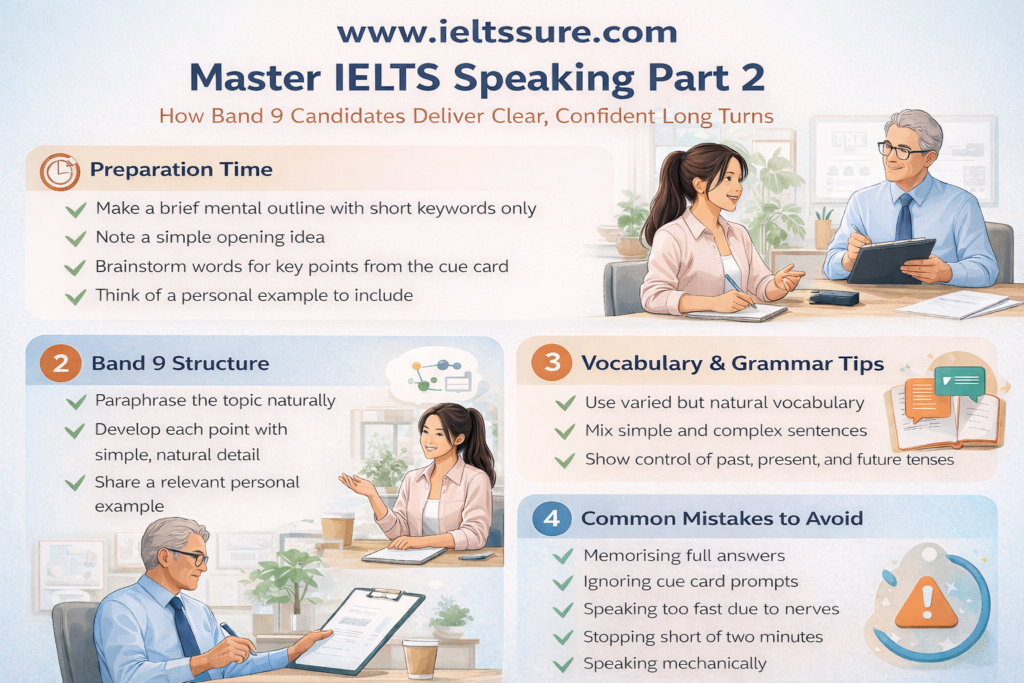
Vocabulary and Grammar That Boost Scores
Advanced vocabulary is helpful, but natural usage matters more. Band 9 candidates choose words they are comfortable with and use them accurately.
They also vary their grammar naturally, including:
- Past, present, and future tenses
- Simple and complex sentences
- Natural linking words like because, although, and as a result
Accuracy combined with flexibility is what examiners reward.
Common Mistakes to Avoid in Speaking Part 2
Many candidates lose marks due to avoidable errors. Be careful not to:
- Memorise full answers
- Ignore the bullet points completely
- Speak too fast or too quietly
- Panic if you forget a word
- Stop before the two minute mark
Pausing briefly to think is perfectly acceptable and does not lower your score.
Final Advice IELTS Speaking Part 2
Speaking Part 2 is about control, not perfection. If you stay organised, speak clearly, and develop your ideas naturally, you can score highly even without complex vocabulary.
Treat the cue card as a guide, trust your preparation, and speak as if you are telling a story to an interested listener. Confidence grows when you focus on communication rather than mistakes.
JOIN OUR WHATSAPP GROUP FOR UPDATES
Frequently Asked Questions about IELTS Speaking Part 2
You should speak for between one and two minutes. Band 9 candidates usually speak close to the full two minutes while staying relevant and well structured.
Write short keywords, not full sentences. Focus on ideas for each bullet point, one personal example, and a simple ending to help you stay organised while speaking.
You should address all bullet points, but not mechanically. Use them as a guide and develop your answer naturally rather than treating them as separate questions.
Yes. Short pauses to think are completely acceptable. Examiners prefer natural pauses over rushing, memorised answers, or repeating ideas.
No. Memorised answers are easy for examiners to detect and can reduce your score. Focus on flexible structures and natural language instead.
Finishing early may limit your fluency score. To avoid this, extend ideas by explaining reasons, describing feelings, or reflecting on why the topic is meaningful.