
The True False Not Given question type is one of the most challenging parts of the IELTS Reading test. Many learners struggle not because the questions are difficult, but because this task requires extremely precise reading skills. In this guide, IELTS Sure breaks the process down into simple steps so you can understand exactly what examiners expect and how to approach every question with confidence.
Table of Contents
JOIN OUR WHATSAPP GROUP FOR UPDATES
What True False Not Given Really Mean
Before you even start answering true, false not given questions questions, you need to be absolutely clear about what each option represents. Misunderstanding the meaning behind these three choices is the biggest reason students lose marks.
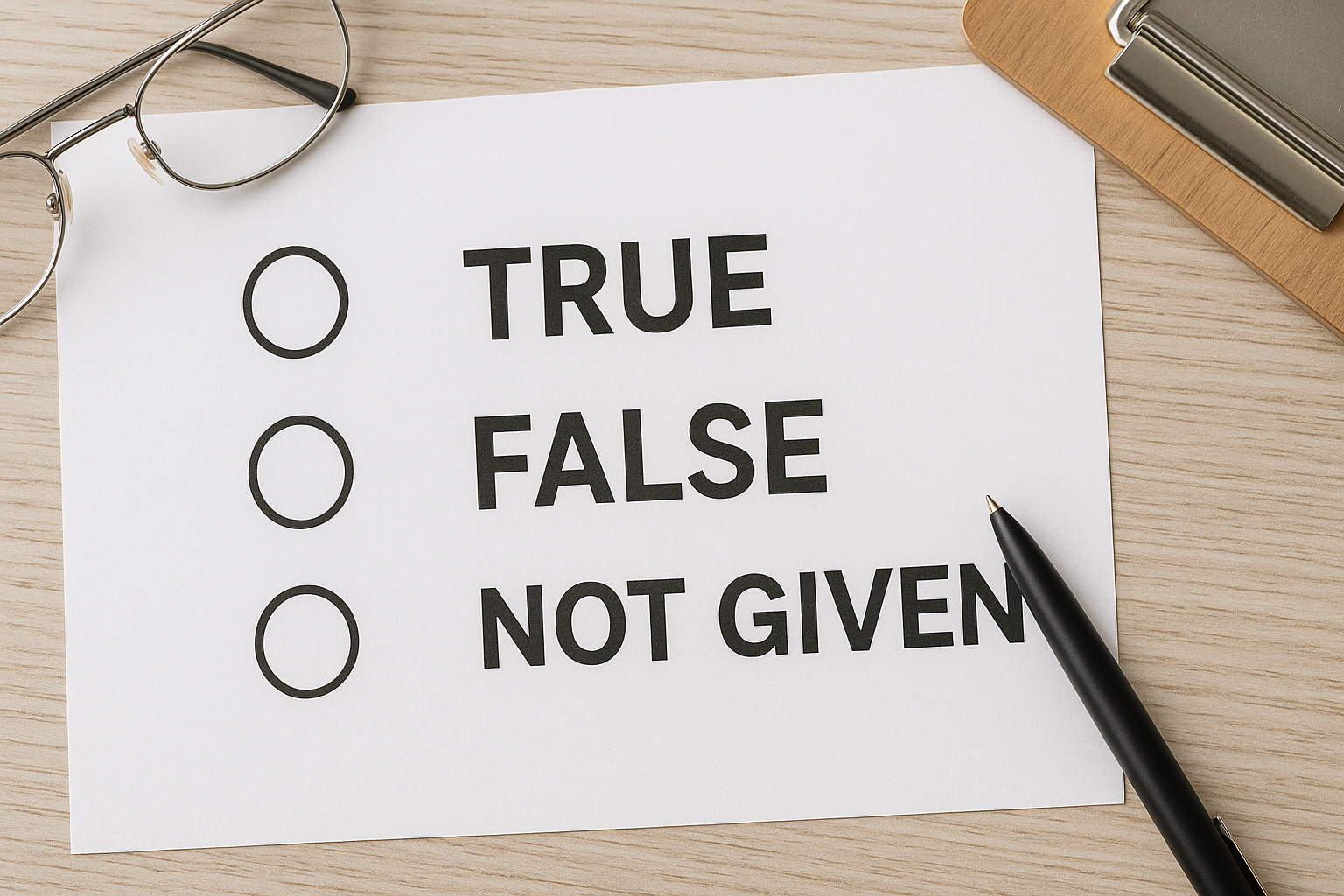
Definitions at a Glance
| Option | What It Means |
|---|---|
| True | The statement agrees with the passage, meaning the text clearly supports it. |
| False | The passage directly contradicts the statement. |
| Not Given | The information is missing, incomplete, or cannot be proven from the passage. |
These definitions may sound simple, but the exam tests how well you notice subtle wording differences.
How to Read the Statements Correctly
A common mistake is reading the statement emotionally or based on your own knowledge. Remember, IELTS is only testing one thing here, which is whether the statement matches the writer’s exact meaning.
Ask yourself three questions:
- Does the passage confirm this idea?
- Does the passage contradict this idea?
- Does the passage fail to mention this idea in a clear way?
Your answer must come directly from the text, not from assumptions or outside knowledge.
ALSO READ: Mastering IELTS Reading: A Band 9 Strategic Blueprint to Achieve Your Dream Score
Step by Step Strategy for Answering True False Not Given Questions
Here is a simple system that makes this question type much easier.
1. Read the Statement Carefully
Look for keywords, such as dates, numbers, names, and strong adjectives. These often guide you to the matching area in the passage.
2. Scan the Passage
Do not read word for word. Scan for the keywords or synonyms. IELTS rarely uses the exact same words, so expect paraphrasing.
3. Match Meanings, Not Words
The statement will often look similar to the text, but one small shift in meaning can change the answer completely.
4. Decide Based on Evidence
If the passage clearly supports the idea, choose True.
If the passage clearly says the opposite, choose False.
If the passage does not fully answer the statement, choose Not Given.

Examples to Strengthen Your Understanding in True False Not Given Questions
Below is a simple table showing how statements are interpreted.
| Statement | Information in Passage | Answer | Why |
|---|---|---|---|
| The museum opened in 1950 | The museum opened in 1951 | False | The information contradicts the statement |
| The museum receives many visitors yearly | The museum is one of the city’s most popular attractions | True | Popularity implies many visitors |
| The museum was designed by a famous Italian architect | No architect is mentioned | Not Given | The text does not confirm or deny the claim |
Practising with examples like these trains your brain to see the difference between missing information and contradictory information.
Common Traps in True False Not Given and How to Avoid Them
Synonym Confusion
IELTS often paraphrases. For example, “a decline” and “a drop” may refer to the same trend.
Partial Information
If the passage mentions part of the idea but not the whole statement, the answer is Not Given.
Overthinking
If you have to guess, the answer is almost always Not Given.
Final Tips for Success in True False Not Given
- Trust only what is written in the passage.
- Do not bring your own knowledge or logic into the answer.
- Watch out for extreme words such as “always”, “never”, “only”, and “all”.
- Remember that True and False require clear evidence, while Not Given requires lack of proof.
Mastering True, False, Not Given questions becomes much easier with consistent practice. With the right techniques and a calm, analytical approach, you will start recognising patterns quickly and improving your reading accuracy for higher IELTS scores.
Frequently Asked Questions About IELTS True False Not Given
+ What does True, False, and Not Given mean in IELTS Reading?
True means the statement agrees with the passage; False means the statement contradicts the passage; Not Given means there is not enough information in the passage to confirm or deny the statement.
+ How can I tell the difference between False and Not Given?
False means the passage clearly says the opposite of the statement; Not Given means the passage does not provide enough information to decide either way.
+ Should I use my own knowledge when answering?
No; you should only use the information from the reading passage. Do not use personal knowledge or outside information.
+ Will the answers be in order?
Yes; in most cases; the answers appear in the passage in the same order as the questions. This helps you locate information faster.
+ Is it okay to answer if I am unsure?
Yes; there is no penalty for wrong answers. Make your best guess; but read carefully before deciding.
+ What is the best strategy for answering True; False; Not Given questions?
Read the question carefully; find matching information in the passage; compare meaning closely; and decide if it is True; False; or Not Given based only on the text.
+ Should I focus on keywords when searching for answers?
Yes; focus on keywords; but also look for synonyms and paraphrased ideas. The wording may change; but the meaning stays the same.
+ What if the question mentions something partially?
If only part of the information is mentioned; and the rest is missing; the answer is likely Not Given.
+ How important is understanding meaning rather than matching words?
It is very important; the test is based on meaning. Matching individual words without understanding the meaning may lead to wrong answers.
+ Are these questions usually difficult?
They can be challenging; especially because they require attention to detail. With practice and correct strategy; accuracy can improve steadily.
+ Does spelling matter when writing answers?
Yes; spelling must be correct. Write the full words: True; False; or Not Given.
+ How can I improve my True; False; Not Given accuracy?
Practice regularly using real IELTS passages; focus on understanding question meaning; and train yourself to identify whether information confirms; contradicts; or is missing.